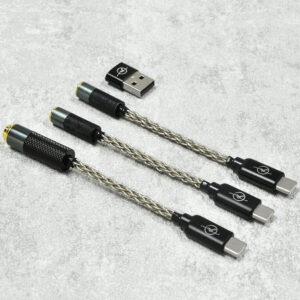
An audio adapter cable should solve one clearly defined connection problem. Before choosing one, identify the source output, the destination input, the signal type and the required direction. A plug that physically fits does not guarantee correct wiring, a compatible balanced connection or digital audio support. HiFiForge offers compact handmade adapters for selected 2.5 mm, 3.5 mm, 4.4 mm, USB-C and Lightning use cases, with the supported direction and construction stated on each product page. If any part of the signal path is unclear, ask for a compatibility check through the Custom Shop before ordering.
How to choose an audio adapter cable
Write down the two endpoints first. For example: “4.4 mm male from the player to 3.5 mm female for the headphone cable,” or “USB-C from the phone to USB-C on the external DAC.” Male and female connectors are not interchangeable, and some adapter products support several selectable versions. Check the option names on the product page rather than relying only on the product photo.
Next, identify whether the connection is analogue or digital. A short USB-C cable used between a compatible source and external DAC carries digital data; it is not automatically a DAC by itself. A 2.5 mm, 3.5 mm or 4.4 mm headphone adapter normally carries an analogue signal. USB-C and Lightning devices vary in the audio modes and accessories they support, so confirm the phone, tablet, player or DAC model before ordering.
Balanced and single-ended wiring requires extra care. A connector-size conversion does not change the underlying amplifier design. Do not assume every balanced output can be adapted to every single-ended input safely. Use only the conversion and direction stated on the product page, and consult the source equipment documentation when the intended combination is not explicit.
Adapter construction can use copper, pure silver, silver-plated copper or a hybrid of conductor materials. Read the copper vs silver vs hybrid audio cable guide to compare complete designs; the correct conversion and direction still come first.
Three useful examples are:
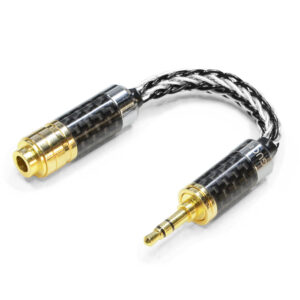
- 7N silver–copper 2.5 mm, 3.5 mm and 4.4 mm audio adapter options
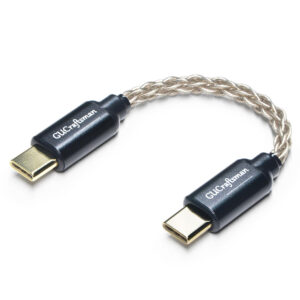
- Shielded 6N silver-plated OFC USB-C to USB-C digital audio cable
- 6N single-crystal silver Lightning to 2.5 mm, 3.5 mm or 4.4 mm female DAC adapter cable
Keep the adapter short unless the setup genuinely needs more reach. A compact adapter reduces strain and clutter around a portable device, but the connectors should not be forced into a tight bend. For a non-standard direction, length or connector combination, send the complete device chain through the Custom Shop so compatibility can be reviewed before quotation.
Audio adapter FAQ
Does a USB-C or Lightning adapter always contain a DAC?
No. Some products are digital interconnects intended for use with a separate compatible DAC, while other products may include conversion electronics. Use the description for the exact product and do not infer the function from the connector alone.
Can I convert any balanced output to 3.5 mm single-ended?
Not safely in every system. The allowed conversion depends on the source design and the adapter wiring. Confirm the exact source, destination and direction before ordering; a physical connection is not proof of electrical compatibility.
What information should I send for a compatibility check?
Include the source device, the output you plan to use, the destination device or cable, both connector genders and the required direction. The Headphone & IEM Cable FAQ explains the general compatibility process. For delivery timing, see Shipping & Delivery, and for workmanship coverage see Warranty & Repair.
Check the complete signal path before ordering. Use the Headphone & IEM Connector Compatibility Guide for the device-side connection and the 2.5 mm, 3.5 mm and 4.4 mm plug guide for analogue source-side terminations.
-
6N Single Crystal Silver
6N Single Crystal Silver USB-C to 2.5mm/3.5mm/4.4mm Female DAC Adapter Cable
$29.99ClearUSB-C to 2.5mm FemaleUSB-C to 3.5mm FemaleUSB-C to 4.4mm Female -
7N Silver/Copper Hybrid Braided
7N Silver & Copper Hybrid Adapter Cable for 4.4mm/3.5mm/2.5mm Connector Conversion
$58.00Clear2.5mm Male to 4.4mm Female3.5mm Male to 2.5mm Female3.5mm Male to 4.4mm Female4.4mm Male to 2.5mm Female